
Watsonville City Directory Collections
The most concrete Watsonville directory holdings are at the Pajaro Valley Historical Association, with additional volumes at Watsonville Public Library, Santa Cruz Public Libraries, UCSC Special Collections, and the California State Library. Access varies by year. A listing on a collection page does not guarantee that every edition is digitized or open on a home computer, so ask about the physical or microfilm copy before planning a long search.
| Collection | Years | Where Held | Access |
|---|---|---|---|
| Watsonville city directories | 1872/1873 to 1985, discontinuous; vault material reported through 1989 | PVHA, WPL, SCPL, State Library | Onsite, reference, selected digital platforms |
| Peckham and Peckham & Swank | 1898, 1899, 1902 | PVHA, UCSC, California State Library MICRO-FILM 209 | Filmed and local holdings |
| County resident and classified directories | 1906-07; 1910-11, 1912-13, 1914-15; later county years | SCPL, PVHA, WPL, UCSC | Reference and onsite |
| Western householder guides | 1916-17, 1918-19, 1920, 1922, 1923-24 | UCSC, SCPL, WPL | Inspect the volume for reverse sections |
| Polk and later county editions | 1925-26 forward; WPL reports Watsonville editions through 1989 | SCPL, WPL vault, UCSC | Catalog title and Watsonville coverage both need checking |
| Register-Pajaronian and related newspapers | 1864-2022 search range across six titles | Watsonville Public Library | Digital archive, microfilm, reference help |
The Pajaro Valley Historical Association directory list is the best first check for exact Watsonville years. PVHA is at 332 East Beach Street, offers public hours Tuesday through Thursday from 11 a.m. to 3 p.m. plus appointments, and provides research by arrangement.
The PVHA historical directory collection shows the local shelf that anchors the Watsonville directory search.
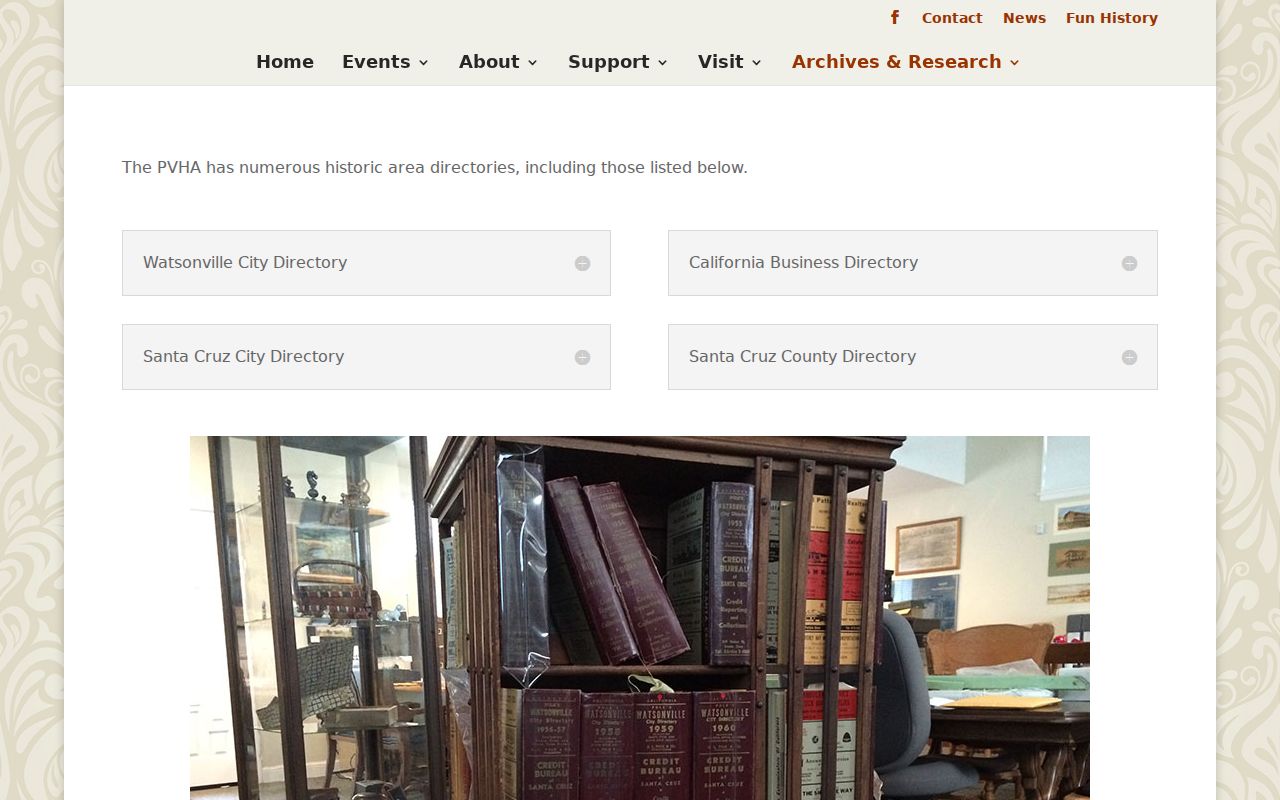
The collection image is a starting point for an exact year request, not a promise that every listed edition is digitized.
Watsonville's 1872 and 1873 Beginning
The first Watsonville directory date needs a catalog note. PVHA labels its earliest item 1872, while the bibliographic guide identifies Edward Martin's Directory of the town of Watsonville for 1873, published in Watsonville by C. O. Cummings. Treat the difference as a cataloging discrepancy, not proof that two separate editions exist.
Copies are reported at PVHA, the Watsonville Public Library vault, UCSC McHenry Special Collections, and the California State Library. UCSC lists call number F869.W32 M355 1873a, while the State Library lists 917.9471.W34dm. Call numbers are shelf clues, not guarantees of open browsing. Ask the repository whether the volume is available, restricted, filmed, or represented by a catalog entry only.
The California State Library genealogy and history page is a useful catalog doorway for older Watsonville material.
The State Library route widens the search beyond one local shelf and can point toward microfilm, maps, newspapers, and catalog records.
Peckham, Western, and Polk in Watsonville
Publishers give the Watsonville city directory its shape. The 1898 Directory of the City of Watsonville, George W. Peckham's 1899 volume, and Peckham and Swank's 1902 Resident directory, Watsonville, California were filmed together as MICRO-FILM 209 California. The Santa Cruz County Directory Company began a regional resident and classified series in 1906. Albert G. Thurston's 1910-15 county books included private citizens, businesses, officials, courts, churches, schools, societies, and a street directory.
Western Directory Company issued the Complete householder's guide of Santa Cruz and Watsonville in several runs from 1916-17 through 1923-24. The phrase is strong evidence for address-first research, but a particular volume still needs inspection. R. L. Polk took over with 1925-26 and later editions. SCPL reports 1926-66, WPL reports Watsonville editions from 1928-88 and a 1989 volume, and UCSC holds substantial runs.
The Santa Cruz Public Libraries local-history guide connects directories with maps, archives, Sanborn sheets, and UCSC Special Collections.
Use the county guide to find a second repository when a volume is missing from the PVHA list or unavailable on the day of a visit.
A Polk Watsonville Title Can Shift
A Polk book can look like a new publication when its lead city or spine changes. The research notes that Polk sometimes repackaged the same county edition under a different city-first title and restarted pagination. From 1965-66 forward, a Santa Cruz-branded edition can omit Watsonville even when the catalog title sounds close. Check the table of contents, place coverage, and title page before calling a year absent.
Likely nonpublication years include 1931, 1942-45, 1947, 1949, and 1951-52. These gaps are not proof that a resident moved or died. A publisher may have skipped a canvass, a repository may lack the volume, or Watsonville may be hidden inside a regional title. Preserve the exact catalog wording when a search spans decades.
Collection tip. Photograph the title page, publisher, year, and contents page before copying an entry; those details explain later differences in coverage.
Reading a Watsonville City Directory Entry
A historical Watsonville city directory entry usually compresses several facts into one line. The sample inspection did not locate an unrestricted page suitable for quotation, so the format below is a convention to verify against the volume in hand. Start with the alphabetic section, then photograph the abbreviation key and the street or reverse section if one exists.
| Name | Surname, given name or initial, often with a spouse in parentheses. |
|---|---|
| Occupation | Trade or workplace clue used to separate two people with the same name. |
| Residence | House number and street, with marks such as h, r, or bds. |
| Family mark | “wid” can identify a widow and suggest a family-history path. |
| Business entry | Business address may be separate from a residence address. |
- Criss-cross section
- The street-order half of a volume, where a number may lead to a listed householder.
- Householder guide
- An address-first directory format; inspect the edition before assuming every year has the same section.
- Abbreviation key
- The volume's own legend for short marks such as h, r, bds, and wid.
“h” commonly means house or home, “r” can mean rooms or resides, and “bds” can mean boards. A directory's language reflects its period and may omit seasonal workers, women, renters, and households outside the canvass. Treat a line as a dated clue, not a present fact.
Watsonville City Directory Abbreviations
When a name search fails, change the search method before changing the person. Try the surname with a middle initial, a spouse, a workplace clue, and a known street. Then check the street section. A surname that disappears may signal a move, a missed canvass, annexation, a street-number change, or a missing year.
Watsonville's agriculture and packing economy create useful historical clues. Strawberries, lettuce, apples, sugar beets, orchards, and packing houses shaped trade labels and newspaper notices. Japanese American, Chinese, Filipino, Mexican American, and agricultural-worker collections can add names that conventional property and commercial directories miss.
The Watsonville Public Library keeps yearbooks, Californiana, cemetery and historic-house resources, civic-organization files, and the California Agricultural Workers' History Center. Those collections can repair a directory gap without pretending the gap is a complete absence.
Trace Watsonville Households Across Years
A good family-history trail alternates directory years with fixed census snapshots. Begin with an exact directory entry, record its spelling, spouse, address, and occupation, and then look for the next available volume. A later change in address may be more informative than a missing name. Pair the address with a deed, newspaper notice, obituary, or probate case only when the role and date agree.
- Find the first Watsonville city directory year that contains the name and copy the whole line, including marks and address.
- Check the next available volume and its street section. Record a move, spouse change, business address, or spelling shift.
- Pair the interval with the 1930, 1940, or 1950 federal census, which can add household relationships, age, birthplace, and address context.
- Use the WPL newspaper archive for an obituary, sale notice, school item, or social notice when the directory run skips years.
- Close the trail with probate, cemetery, naturalization, military, or family-history material held by the relevant archive.
A directory year can reflect a canvass made before the cover date. A census date is a fixed enumeration snapshot. A deed date marks an instrument, not necessarily occupancy. Preserve those date labels rather than smoothing them into one timeline.
Watsonville Newspapers and Census Fill Gaps
WPL's historical newspaper portal searches six titles from 1864 through 2022: Pajaro Valley Times, Santa Cruz and Pajaro Times, Pajaronian, Evening Pajaronian, Watsonville Morning Sun, and Register-Pajaronian. The library's Digital Reel tutorial explains keyword search, date browsing, enlargement, enhancement, printing, and saving. OCR may misread small type or Spanish names, so browse around the likely date when the exact search fails.
The county guide also points toward UCSC maps and aerial photographs, Hihn-Younger and Leon Rowland collections, and Sanborn maps. A Sanborn sheet shows building footprint, use, and material. It is physical evidence, not an occupant list. Census schedules through 1950 are public under the 72-year rule, while later years follow their release schedule.
For a visual cross-check, the Library of Congress Watsonville Sanborn sheet can anchor a building-era comparison; inspect the sheet and address index before treating it as evidence.
The city's historic-context statement can add neighborhood-era vocabulary when a directory skips a year, but it is context rather than a resident list.
The Watsonville Library local-history page brings the newspaper and obituary route into one local starting point.
Library reference staff can help with obituary requests at 831-768-3404, while the directory volume still needs its own shelf or scan check.
Where Watsonville City Directories Sit
PVHA's Borina Archive and Alzora Snyder and Jane Borg Research Center works by membership or special arrangement at 332 East Beach Street. Published research charges are $15 per hour for a trained member or student and $20 per hour for other researchers, with separate collection-check, scan, enhancement, copying, postage, and packaging charges. A family-record request is more useful when it includes names, dates lived locally, schools and years, business, spouse, and parents.
WPL is at 275 Main Street and 831-768-3400. UCSC Special Collections is at 1156 High Street in Santa Cruz, 831-459-2547, with maps, photographs, and the Watsonville-Santa Cruz JACL material being processed. FamilySearch requires a free account, and WPL's Ancestry Library Edition is in-library only. The California State Library and SCPL are additional catalog and microfilm routes.
Start with the collection that holds the needed year, then use the Watsonville street directory page for modern address-keyed records. A historical volume can identify a former householder, but the present APN and deed layer belongs with the county offices.